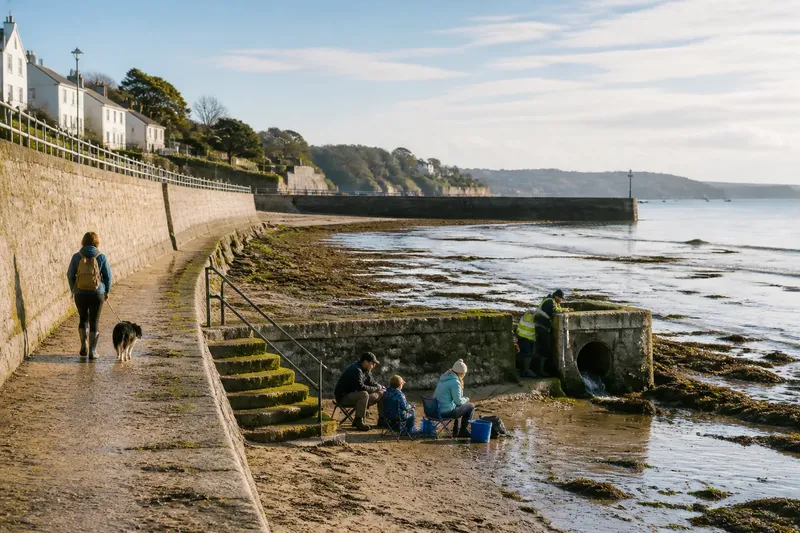
From Seaside Promenade to Public Waterfront
A seaside promenade can welcome gatherings, everyday walks or careful access through a working coast. Learn to read its public cues and understand what suits the place.
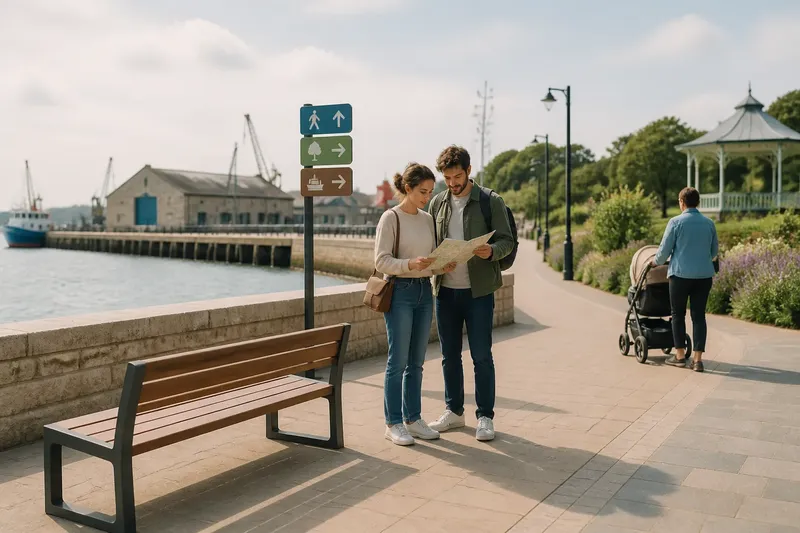
A bench faces the water while a couple stops to check a map, and behind them a pushchair rolls past on the same paved strip. A seaside promenade has to make room for both lingering and moving on. Its public character depends on how well the waterfront tells people where they can enter, pause and continue.
The word promenade can describe a formal terrace, a long waterside path or a chain of public spaces. Rather than judging by paving or sea views alone, it helps to ask what role the place gives priority: gathering, walking or making boundaries clear along a varied shore.
The civic room
Some promenades work like outdoor civic rooms. Their paths invite people to stop as well as pass, with a broad terrace, a sheltered bench, a bandstand or a generous seawall helping to give the place a centre. The waterfront becomes a shared setting for ordinary social life, not simply a line between destinations.
Details shape who can use that room comfortably. A wall may double as seating; steps may bring people closer to the water where conditions permit. Planting, lamps and shelters can make the space more inviting, but they also affect sightlines, movement and upkeep. A few well-placed places to pause may serve people better than a crowded assortment of features.
There is a trade-off. Seats all facing the sea may offer a fine view but make conversation awkward. A large event space may leave quieter visitors feeling pushed aside. A successful civic room offers more than one way to stop, without letting furniture obstruct the route through it.
The walking link
Other promenades put continuity first. They connect neighbourhoods with parks, beaches, transit stops or harbour destinations, and make it clear where the public route goes next. For residents, that link may be part of an everyday journey; visitors may value it as a longer walk.
Look beyond the waterside paving. A path that meets a confusing road crossing, a locked gate or an unclear private frontage may not feel continuous to the person using it. Readable entrances and connections to side streets matter, as do places to rest that do not narrow the through path.
Not every section needs the same character. A path beside a working harbour has different needs from one passing shops and public seating. Clear signs and visible connections can help people understand how the parts join, without making them look identical. A route also needs occasional invitations to pause; an uninterrupted line with nowhere to rest can feel like a passage rather than a public place.
The public threshold
On some coasts, access comes as a sequence of public spaces rather than one unbroken promenade. A route may pass an open terrace, a working quay, a beach entrance and a wetland edge. The public value lies in making each accessible part easy to find and in explaining how it connects to the next.
Where port operations, habitat or changing water levels limit access, a viewing platform or a small public landing may be more suitable than an open route along the whole shore. Boundaries should be clear: signs can explain closures, while a railing, a change in paving or planted buffer can show where public movement belongs. A public path should not suggest that visitors may enter operational or restricted ground.
The challenge is making these different places feel connected. Consistent signs and visible entrances can help people follow the public route, even when its character changes from one segment to another. The aim is not to hide the limits, but to make them understandable.
Questions about promenades?
Does a promenade need to be continuous?
No. A continuous path can support longer journeys, but a gap may be appropriate beside sensitive habitat or an active port. Any public links between accessible sections should still be legible.
How can I tell where access is public?
Look for visible entrances, clear signs and spaces that invite people to pause without appearing reserved for customers. If the boundary is ambiguous, check local public-access information rather than assuming that a path is open.
Should a promenade feel lively or quiet?
That depends on neighbouring homes, shops, wildlife and existing waterfront uses. A terrace near a town centre may support conversation, while a path beside homes or habitat may suit a quieter approach.
How do I compare different designs?
Start by identifying whether the main public need is gathering, walking between places or finding a clear way through a varied coast. Then consider whether secondary needs—such as resting, accessible passage and separation from working areas—are also addressed.
Reading the waterfront
Say a fictional harbour town has a market street ending at a seawall, a working quay nearby and a small park farther along the coast. The town’s invented starting brief is to connect market visitors with the park while keeping the quay operational.
- It marks the seawall end as a public gathering place, with seating set back from the through route; the intended observable result is that people can stop without blocking walkers.
- It traces the public path from the market to the park, checking each entrance and crossing; if the route becomes unclear at the quay, the town identifies a legible public connection around the restricted area instead.
- It places signs at the market entrance and at the quay boundary; if visitors can tell which way to the park and where access ends, the signs are doing their job, and if not, the town revises their position or wording.
- It checks whether the route offers a place to rest outside the working area; if it does, the town keeps that pause point, and if it does not, it considers a suitable public stopping place along the accessible section.
In this invented situation, the resulting choice is a small civic terrace linked to the park by a clearly marked public route that avoids the working quay. The trade-off is that the waterfront is not a continuous waterside walk, but its gathering place, public connection and operational boundary are easier to understand.
Think of the promenade as a shared hallway: people need room to pass, but a useful seat or doorway can make it welcoming. Along the coast, the equivalent is a clear balance between gathering space, walking line and boundaries that protect other uses.
When comparing a seaside promenade with a broader public waterfront, notice where people slow down, where they hesitate and whether the public route is easy to recognise. A civic room needs room to stay; a walking link needs clear passage; a threshold needs honest boundaries. The seaside promenade works best when its public cues fit the shore around it, even if the next stretch serves a different purpose.