Boardwalk or Beach Path: What Changes Underfoot?
Boardwalk or beach path choices affect views, footing and access to the shore. Compare the surfaces and see what to consider for a coastal walk.
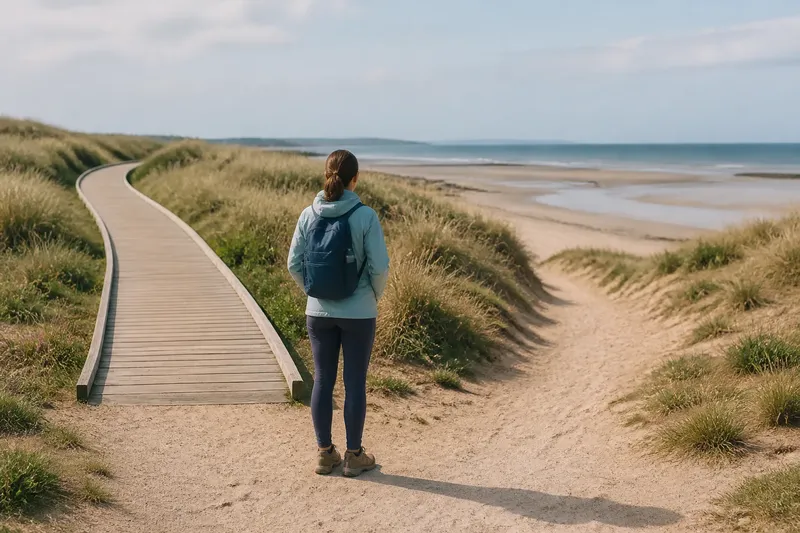
A walker reaches a sandy fork above the beach and pauses: one route crosses timber decking, while the other follows the shore at ground level. Choosing a boardwalk or beach path changes the view, the feel underfoot and how easily visitors can reach the water.
Route and viewpoint
A raised boardwalk gives walkers a defined line through the landscape. From the deck, dune tops may sit below the horizon, leaving a broad view towards the sea. A low path offers a different perspective: grasses, sand and small pools can occupy more of the view, with the beach close at hand.
Neither route is simply a neutral way to reach the same place. A boardwalk can make the coast feel like a panorama to look across; a shore-level path brings the texture of the ground into the walk. It is a little like choosing between a window seat and a bench beside the water: both offer a view, but they place you differently in the scene.
Footing and pace
Decking creates a distinct walking surface, which can feel more consistent than loose sand. Damp boards, gaps and changes in level can still affect someone’s footing. A low path varies with its material and condition: compacted ground may be firm, while soft or shifting sand can slow a walker and require more attention.
The difference shapes how people use the route. A clear deck can help walkers keep to a line and pass one another. On a beach-level path, people may stop to look at shells or water channels, but uneven ground can make those pauses less predictable for others approaching from behind.
Access to the shore
A raised route can guide visitors over or around ground that is easily worn. Yet it may leave the beach just beyond reach unless there is a suitable connection down to the sand. A low path offers more immediate contact with the shore, although frequent foot traffic can widen the track or wear at a fragile edge.
Look beyond the main stretch to the entrance and any changes in surface. Steps, steep approaches, narrow passing places or soft ground can make a route difficult for some visitors. A level approach and a firm surface may help, but the whole journey matters: a smooth deck does not solve a difficult connection at the beach end.
Questions walkers ask?
Is a boardwalk easier to walk on?
It may provide a more consistent surface than loose sand, though its condition, width and level changes still matter. A firm, well-kept path at beach level may be comfortable too.
Does a boardwalk protect dunes?
It can keep feet off vulnerable ground if the route and access points guide people where they should go. The supports and connections also need to suit the setting, and unclear beach access may encourage visitors to leave the deck.
Which route feels closer to the sea?
A low path usually brings walkers nearer to sand, water and the changing shape of the shore. A boardwalk can open the view while keeping the walking surface separate from the beach.
Can both routes work together?
They can serve different purposes where the site has suitable space and clear connections. A raised section might cross delicate ground, while a separate low route offers a closer approach to the shore.
What to check
Before choosing a route, look at what is on the ground and how people will use it. Each observation points towards a practical decision, rather than a universal preference for timber or sand.
- Check whether the approach has steps or a steep slope; if it does, consider a level alternative, then check whether that route connects to the shore.
- Check whether the walking surface is firm or shifting; if it is soft or uneven, consider a raised or firmer route, otherwise assess whether a low path can remain clearly defined.
- Check whether people need to pass one another; if the route feels narrow at likely stopping places, consider a wider section or a separate place to pause.
- Check whether vulnerable plants or easily worn ground lie across the desired line; if they do, consider routing people around or over that area, otherwise avoid adding a structure without a clear need.
- Check where visitors can reach the beach; if a boardwalk ends above the sand without a suitable connection, consider a clear access point or a low approach instead.
- Check whether water crosses or collects on the route; if it does, consider a line that leaves room for drainage, otherwise confirm that the chosen surface still suits the site.
A worked choice
Imagine a council considering two routes from a level village lane to a beach. For this invented situation, the starting observations are a patch of easily worn dune plants beside the most direct line, firm ground around the patch, and a sandy opening that provides access to the water.
The council first marks the plants and rules out a path directly across them. It then compares a boardwalk around the patch with a low path on the firm ground. Because the low path can avoid the plants and reach the existing sandy opening, the council chooses it for the main route. The expected observable result is a clearly marked walking line that stays on firm ground and meets the beach access point. The trade-off is that walkers remain at ground level and may have a less open view than they would from a raised deck.
For a real coastal project, surface design, access requirements, permissions and maintenance depend on the site and local rules. A boardwalk or beach path works best when its route matches the ground, the people using it and the way they are meant to reach the shore.